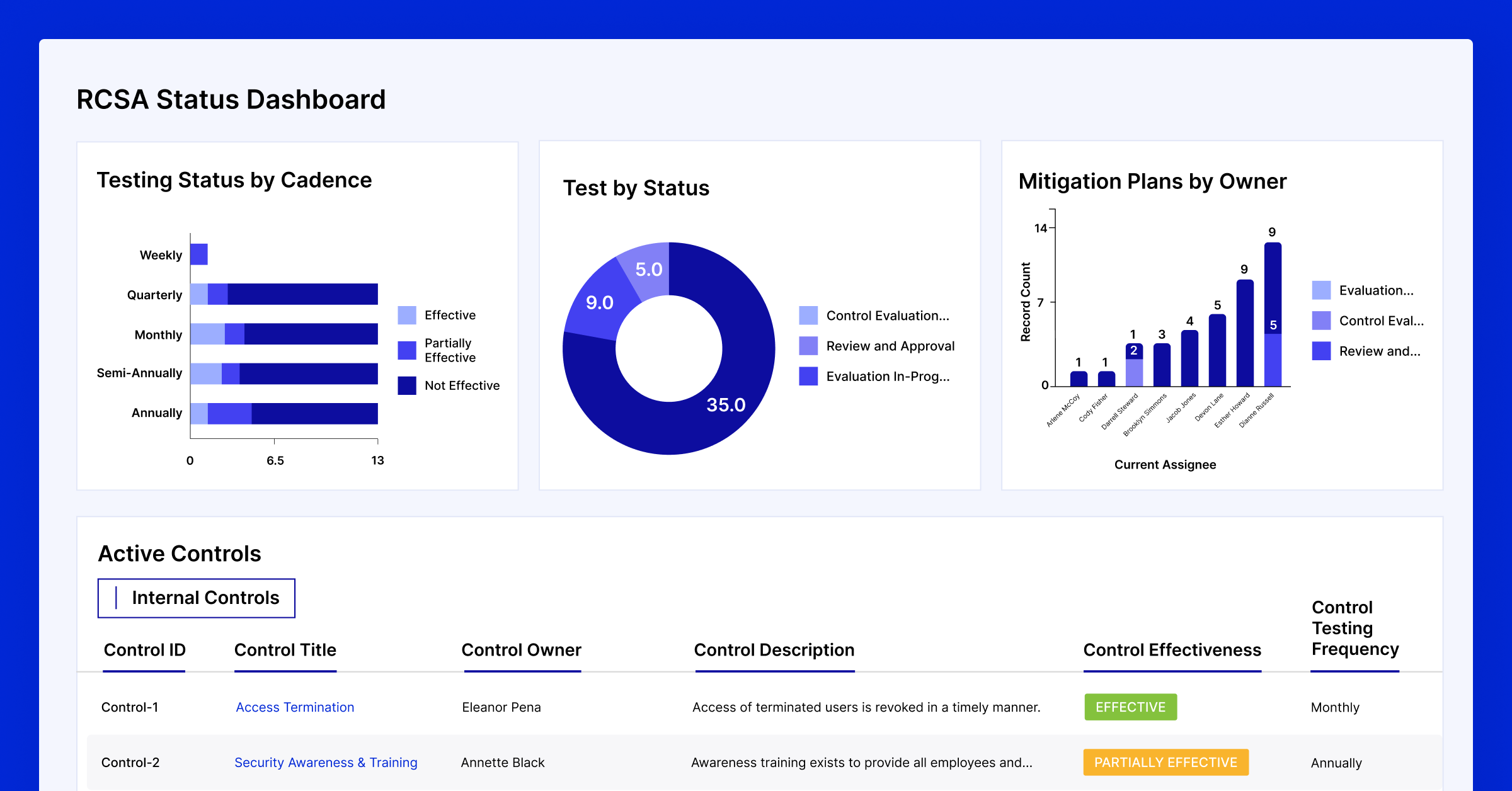
If you work in financial services, you know your institution operates under constant scrutiny from multiple regulatory bodies—the Federal Reserve, FDIC, CFPB, and FINRA, to name a few. You’re managing regulations like AML (Anti-Money Laundering), BSA (Bank Secrecy Act), and KYC (Know Your Customer) each demand high standards of integrity, transparency, and risk management. On top of these regulatory demands, you’re likely relying more heavily on third-party vendors, especially as Banking as a Service (BaaS) expands across financial services. Each new vendor relationship introduces cybersecurity risks, particularly when you don’t have the bandwidth or tools for thorough oversight.
Key Takeaways
- Regulatory Complexity: Financial institutions must navigate a dense landscape of AML, BSA, and KYC regulations under multiple governing bodies.
- Centralized Visibility: Moving away from disconnected systems to a unified GRC platform provides real-time insights into risk exposure.
- Automation is Critical: Automating risk assessments and evidence collection reduces manual errors and speeds up issue resolution.
- Third-Party Oversight: Continuous monitoring of vendor security practices is essential to mitigate risks introduced by BaaS and external partners.
- Strategic Reporting: Customizable, role-based dashboards allow CCOs and CROs to track KRIs and KPIs for data-driven decision-making.
What Challenges Affect Banking Compliance and Risk Management?
- Keeping Up with Regulatory Compliance: As your operations and assets under management scale, regulatory requirements multiply and become more complex to track.
- Cybersecurity Threats: Your institution remains a top target for sophisticated cyberattacks that put customer financial and personal data at significant risk.
- Operational Inefficiencies: If you’re working across disconnected systems with manual processes, you’re likely dealing with bottlenecks, missed deadlines, and human error.
- Third-Party Risk Management: As you depend more on external vendors, you need effective oversight to manage third-party risk proactively, not just at onboarding, but continuously.
To stay ahead, you need a comprehensive GRC approach that unifies risk management, compliance, and cybersecurity in one place, not scattered across spreadsheets and disconnected tools. That’s the gap Risk Cloud is designed to fill.
How Does Risk Cloud Solve Challenges for Financial Institutions?
LogicGate’s Risk Cloud has purpose-built Solutions for the financial sector. You get all the elements of GRC in a single, flexible platform,so you can move faster, reduce manual work, and make more confident decisions.
- Gain Real-Time Insights with Centralized Risk Data: If your risk data lives in disconnected systemsand it probably does – you’re missing a full view of compliance and risk exposure. Risk Cloud centralizes this information in one platform, giving you an at-a-glance view of compliance across AML, BSA, KYC, and other regulations. With real-time visibility, you can manage regulatory obligations proactivelyNo more overlooked issues or last-minute scrambles before audits.
- Automate Risk and Control Self-Assessments: Manual processes drain your team’s time and slow down response when you need to move quickly. With Risk Cloud, you can automate assessment scoping, evidence collection, and task assignments across your entire risk assessment process. Risk Cloud’s Spark AI can help you draft policies, generate response plans, and identify compliance gaps automatically, so you spend less time on manual documentation and more time on strategic risk decisions. That means more efficient operations, less manual work, and quicker issue resolution,so you can focus on high-impact work instead of administrative tasks.
- Manage Third-Party Risk with Confidence: As you rely more on third-party providers, each with their own security standards and practices, you need continuous visibility into vendor risk. Risk Cloud’s Third-Party Risk Management application lets you monitor vendor security practices continuously across your entire vendor ecosystem. With continuous monitoring, you can minimize third-party vulnerabilities and reduce both regulatory and reputational risk.
- Quantify Risk in Financial Terms: With Risk Cloud Quantify, you can translate cyber, operational, and third-party risks into dollar amounts using Open FAIR methodology. This helps you prioritize investments, justify budgets to leadership, and demonstrate the financial impact of your GRC program.
- Strengthen Cybersecurity and Response: Cyber threats are more sophisticated than ever, but you can stay ahead by centralizing cyber risk data and automating your response workflows. You can accelerate cybersecurity response by aggregating real-time cyber risk, vulnerability, and incident data in Risk Cloud, then automating assessment and mitigation workflows. This helps you safeguard customer data, protect your institution’s reputation, and minimize the risk of costly data breaches.
- Access Customizable Dashboards for On-Demand Reporting: With Risk Cloud’s customizable dashboards, you can track key metrics at a glance across compliance, risk, and cybersecurity. Role-based dashboards give you real-time insights into KRIs and KPIs tailored to financial services. You can respond faster to risks, support strategic decision-making, and give management and stakeholders clear, data-driven reports on program performance.
Scale Your GRC Program with Risk Cloud
Risk Cloud helps you tackle your biggest GRC challenges—from regulatory compliance to cyber risk, without adding headcount or complexity. With regulatory compliance, cybersecurity, and vendor risk management in one platform, you can move away from fragmented processes and stay focused on what matters most: serving your customers securely and effectively.
What You Get with Risk Cloud for Financial Services:
- Connect All Three Lines of Defense: Out-of-the-box workflows connect stakeholders across your first, second, and third lines of defense. You get clarity and transparency in regulatory, risk, controls, policy, and issues data—when you need it.
- Accelerate Time-
Toto-Value: You get pre-built assessments designed for banking—including KYC, AML, CFPB, FFIEC, OSFI, and Complaints Investigation—so you can start faster. - Centralize and Cross-Map Regulatory Requirements: Natively supported controls content aligned to industry standards, including:
- Banking & Finance: FFIEC CAT, GLBA, 23 NYCRR 500
- Security & Privacy: NIST CSF, PCI DSS, GDPR, CCPA
- Align to Banking Industry Standards: You get recommended risk and control libraries created specifically for banking organizations by LogicGate’s GRC Content and Strategy team.
- Create
Aa Clear Path Toward Program Maturity: Solution Success Kits are based on your program’s current maturity level, meeting you where you are today and helping you mature over time without costly change orders.
Risk Cloud helps you navigate regulatory complexities, strengthen your cybersecurity defenses, and streamline operations, all from a unified platform.
Ready to learn more? Book a demo today and see how LogicGate’s Risk Cloud platform is transforming Risk and Compliance for financial institutions.
Frequently Asked Questions
Risk management in banking is the process you use to spot, measure, and reduce threats that could harm your finances, data, customers, or reputation. It includes credit, market, operational, cybersecurity, and compliance risks tied to laws like AML, BSA, and KYC.
Banks track seven core risks:
Credit: Customers might not repay loans.
Market: Investments can lose value.
Liquidity: Cash may not be available when bills come due.
Interest-rate: Shifts in rates cut into profits.
Operational: Failures in people, processes, or tech.
Compliance: Fines or penalties for breaking rules.
Reputation: Bad news that drives customers away.
Use a three-step approach:
Inventory vendors: Keep one up-to-date list of every outside partner.
Assess and score: Review each vendor’s security, financial health, and compliance posture before and after they sign a contract.
Monitor continuously: Track changes all year with automated questionnaires, evidence collection, and alerts. Platforms like LogicGate’s Risk Cloud streamline each step so you see issues early and act fast.
Real-time dashboards let you see open issues, overdue tasks, and control gaps the moment they appear. You can fix problems before audits, keep leaders informed, and give regulators fresh evidence during exams—saving time and cutting fines.
Automation:
Sends surveys: Tasks go to the right owners on schedule.
Collects evidence: Documents upload directly into each control record.
Scores risks: The system calculates inherent and residual risk automatically.
The result is quicker assessments, fewer data entry errors, and more time for your team to focus on the highest-impact risks.