There’s a quiet assumption embedded in how most enterprises manage governance, risk, and compliance (GRC). It goes something like this: if we have a risk register, an audit calendar, and a team keeping up with compliance obligations, we’re covered.
In 2026, that assumption is being stress-tested across every industry, and the gap between programs designed for yesterday’s risks and today’s reality is widening fast.
The modern enterprise doesn’t have a risk problem. It has a visibility problem. A cybersecurity vulnerability becomes a regulatory exposure. An AI deployment without proper governance becomes a reputational liability. A controls gap identified in one team goes undetected in another for months. Each of these is a risk. None of them shows up in a fragmented, siloed GRC program until it’s too late to act proactively.
The cost of that architecture is no longer just operational. It’s strategic. And the GRC market is responding accordingly.
The Regulatory Environment Has Outpaced Traditional GRC Models
The pace of regulatory change continues to accelerate. The EU AI Act, DORA’s continuous monitoring mandates for critical financial vendors, and the SEC’s 4-day disclosure rule for material cyber incidents have redrawn the compliance map for global enterprises in a very short time. What was once a managed, predictable compliance calendar has become a dynamic, real-time obligation with material consequences for failure.
In this environment, the traditional GRC operating model consisting of periodic assessments, manual evidence collection, and disconnected point solutions doesn’t just create inefficiency, it creates blind spots. A controls team and an internal audit team independently discover the same gap, weeks apart, with no shared data and no connected workflow. A risk identified in cyber has no visibility in third-party risk. An AI use case moves into production without triggering a governance review because the approval process lives in email.
The data existed. The connections did not.
The Analyst Community Has Taken Notice
We believe that the conversation around enterprise GRC has fundamentally shifted.
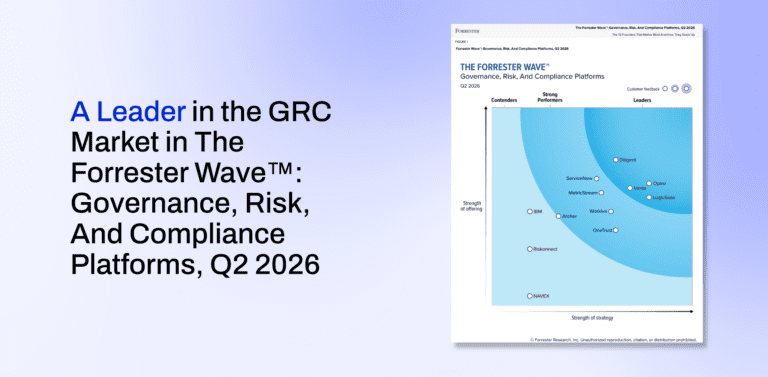
The Forrester Wave™: Governance, Risk, And Compliance Platforms, Q2 2026, published by Forrester Research, Inc., evaluated the most significant GRC platform providers against a set of criteria that reflects how dramatically the requirements have evolved. It is no longer sufficient to manage risks and controls in isolated modules. The evaluation measures a platform’s ability to connect data across risk domains, embed AI meaningfully into practitioner workflows, and translate GRC activity into defensible, leadership-level insights.
What a Connected, AI-Driven GRC Program Looks Like
The alternative to siloed GRC isn’t more tools. That approach trades one inadequate model for a more expensive version of the same problem. A truly modern program operates at the speed of the organization and treats GRC not as a series of point-in-time audits, but as a continuous intelligence and orchestration layer that flows across teams and informs decisions at every level.
Connected risk data, not departmental silos. When a vulnerability surfaces, a connected program reveals its impact across cyber risk, third-party relationships, and compliance programs simultaneously, without a manual triage process. LogicGate’s graph database architecture is built specifically for this type of multi-hop, cross-domain data relationship, enabling teams to see how risk flows across the entire enterprise in real time.
AI that goes beyond task automation and augments practitioner judgment. The real promise of AI in GRC is precision, not just speed. Spark AI enables teams to move faster on assessments, surface patterns in risk data that manual review would miss, and generate insights that shift GRC from a reporting function to a decision-support engine. When the risk landscape moves faster than any team can manually track, AI is what closes the gap.
Implementation that doesn’t require months of services work. One of the most underappreciated bottlenecks in GRC transformation is the implementation itself. Config Newton, LogicGate’s agentic GRC engineer, accelerates initial configurations and reduces reliance on professional services. This enables organizations to go from signed contract to productive program in 90 days or less. For customers like BCU, that speed translated directly into 50 hours of recovered capacity annually from a single automated workflow.
Insights that translate at the board level. GRC programs that can’t demonstrate quantified impact will always fight for budget. Risk Cloud Quantify® gives teams the tools to move beyond activity metrics to dollar-denominated insights, reframing GRC from a cost center to a demonstrable value generator for risk mitigation, resilience, and trust.
What the Forrester Evaluation Confirms
LogicGate was named one of only four Leaders in The Forrester Wave™: Governance, Risk, And Compliance Platforms, Q2 2026, receiving the highest scores possible across eight criteria, including Integration Quality, Technology Risk Management (ITRM), User Experience, Workflow Management, Roadmap, Partner Ecosystem, Adoption, and Pricing Flexibility & Transparency.
According to the report, “LogicGate excels in intuitive user experience and workflow management.” And on the question of where the platform is headed: “LogicGate’s roadmap shines with ambitious plans to embed agentic AI meaningfully across core GRC workflows to bolster practitioner productivity.”
Forrester’s take on fit is direct: “LogicGate is a good fit for customers that want a GRC platform with strong technology risk management capabilities and prioritize fast implementation.”
We believe that assessment reflects the operational reality for most enterprise GRC teams right now. The window between identifying a risk and needing to act on it has collapsed. Speed of implementation, depth of connectivity, and clarity of insight are no longer differentiators. They are table stakes.
GRC Is Not a Back-Office Function Anymore
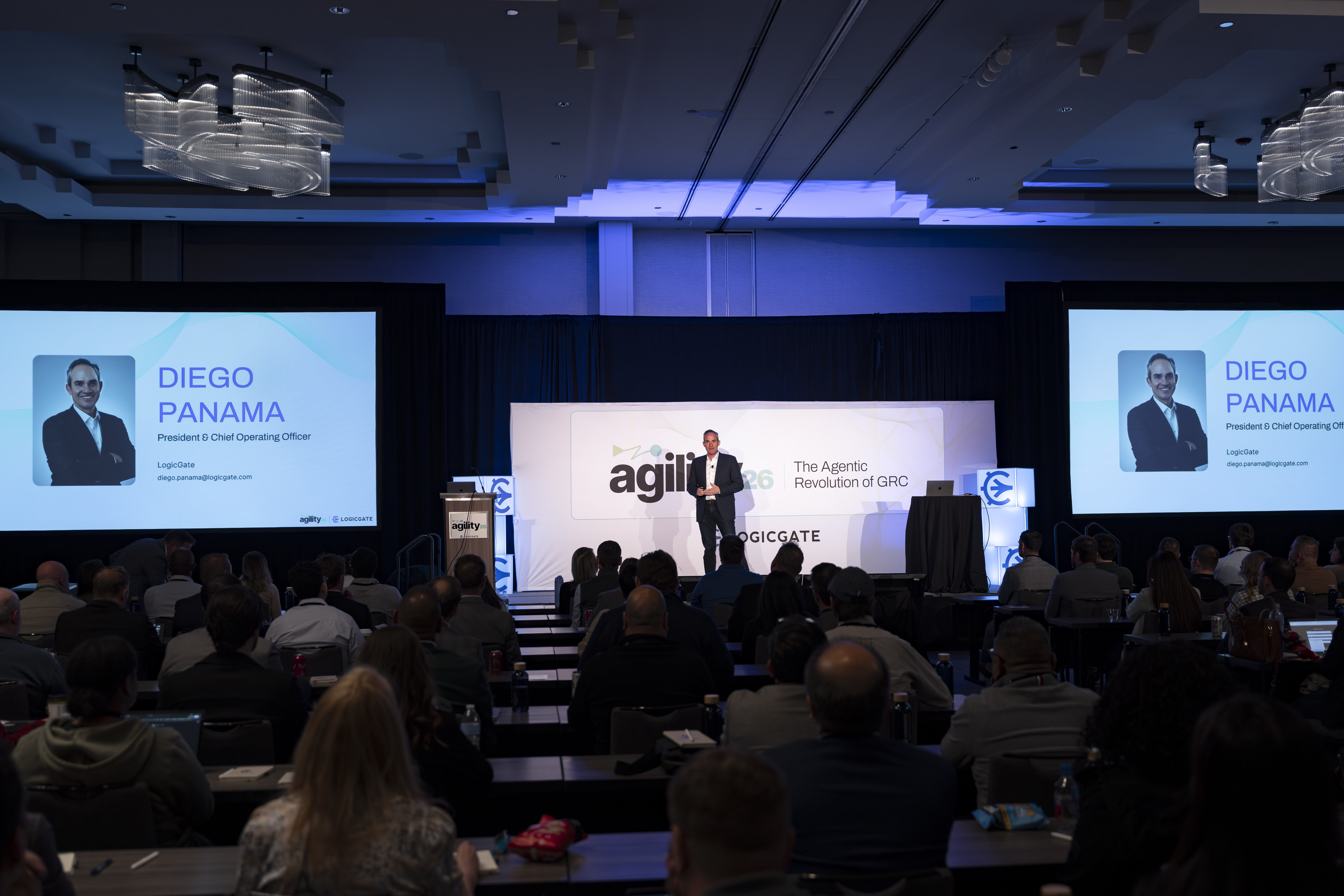
“Our roadmap shines with customers because we are meaningfully embedding Agentic AI into core workflows to deliver performance and more accurate outcomes,” said Diego Panama, incoming CEO of LogicGate. “LogicGate is uniquely positioned to support the world’s most innovative companies to scale their GRC programs.”
The infrastructure to move beyond the spreadsheet era exists. The question for enterprise GRC leaders in 2026 isn’t whether the old model is sufficient, because it demonstrably isn’t. The question is how quickly you can build something better.
Access The Forrester Wave™: Governance, Risk, And Compliance Platforms, Q2 2026 report.
Forrester does not endorse any company, product, brand, or service included in its research publications and does not advise any person to select the products or services of any company or brand based on the ratings included in such publications. Information is based on the best available resources. Opinions reflect judgment at the time and are subject to change. This report is part of a broader collection of Forrester resources, including interactive models, frameworks, tools, data, and access to analyst guidance. For more information, read about Forrester’s objectivity here .
The Forrester Wave™: Governance, Risk, And Compliance Platforms, Q2 2026, Forrester Research, Inc., May 2026
Frequently Asked Questions
The Forrester Wave™: Governance, Risk, And Compliance Platforms is an independent evaluation published by Forrester Research, Inc. that assesses the top GRC software providers across current offering and strategy criteria. It is designed to help enterprise technology buyers understand the competitive landscape and identify platforms best suited to their needs.
A Leader designation in the Forrester Wave™ indicates that a vendor scored among the highest in the evaluation across current offering and strategy criteria. Forrester does not endorse any vendor; the designation reflects an independent assessment based on available information at the time of publication.
Agentic AI in GRC refers to AI systems that can autonomously execute governance, risk, and compliance tasks — such as performing initial risk assessments, validating controls in real time, and generating remediation recommendations — without requiring manual initiation for each action. LogicGate’s Spark AI and Config Newton agent are examples of this capability applied to GRC workflows.
The Q2 2026 Forrester Wave™ for GRC Platforms evaluated providers across criteria including integration quality, user experience, workflow management, technology risk management, roadmap, partner ecosystem, adoption, and pricing flexibility, among others.