There’s a quiet assumption embedded in how most enterprises manage third-party risk. It goes something like this: if we sent out the surveys, collected the SOC 2 reports, and checked the boxes, we’re covered.
In 2026, that assumption is one that security and GRC leaders are being forced to revisit.
The modern enterprise is only as resilient as its most vulnerable partner. And today, every major organization operates as a massive, interconnected ecosystem of hundreds—often thousands—of vendors, suppliers, and service providers. This extended enterprise is the literal backbone of your operations. It’s also your largest, most dynamic, and most unpredictable attack surface.
The scale of the problem is no longer theoretical. According to the 2026 Black Kite Third-Party Breach Report, we’ve entered an era of cascading failures. A single vendor breach now hits an average of 5.28 other companies—the widest blast radius ever recorded. The 2025 SecurityScorecard Global Third-Party Breach Report put an even sharper point on it: 35.5% of all breaches now originate from third-party compromises, and 41.4% of ransomware attacks involve a third-party access vector.
These aren’t edge cases. They’re the new baseline.
The Industry Is Paying Attention—And So Are Regulators
Two signals in the past year confirm to us that the TPRM conversation has elevated.
First, Gartner® returned to the GRC market for the first time in over a decade with the release of the Gartner® Magic Quadrant™ for GRC Tools, Assurance Leaders in 2025. In our opinion, the fact that Gartner felt compelled to re-enter this space after more than 12 years is itself a statement. Governance, risk, and compliance have become mission-critical infrastructure.
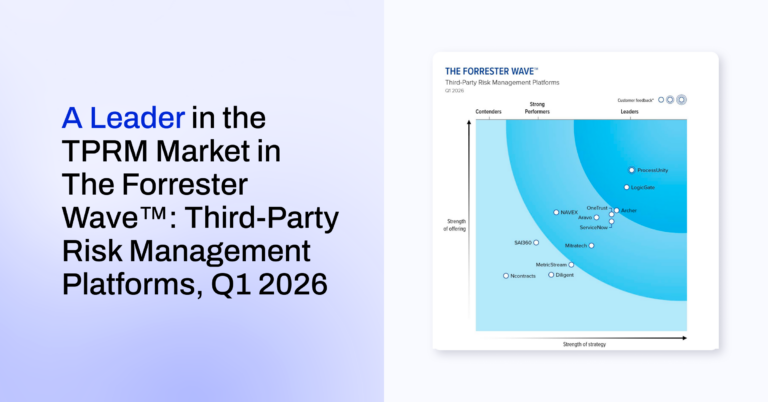
Second, The Forrester Wave™: Third-Party Risk Management Platforms, Q1 2026, identifies the most significant TRPM providers in the space.
The criteria for being a leader in the TPRM space have evolved to match the complexity of the modern supply chain. It’s no longer sufficient to maintain a static vendor list and schedule annual reviews. Today, platform maturity is measured by a program’s ability to use AI and automation to solve the two most persistent and costly problems in TPRM: the friction of vendor onboarding, and what the Black Kite report identifies as the “Silent Window”—the 117-day gap between when a breach occurs and when it becomes public knowledge.
That gap is worth sitting with for a moment. An average of 117 days. Nearly four months during which your organization may be actively compromised through a vendor’s systems, with no visibility, no alert, and no recourse. During that window, attackers use stolen vendor credentials to move laterally through your environment, quietly, methodically, and completely undetected.
Meanwhile, the SEC’s 4-day disclosure rule for material breaches is in effect. If you don’t find out your vendor was breached until four months after the fact, you’re likely already in violation of federal disclosure requirements before you’ve had a chance to respond.
Regulators aren’t waiting for organizations to catch up. DORA, the EU’s Digital Operational Resilience Act, now mandates continuous monitoring for critical vendors for financial entities. The shift in regulatory posture is the same across every major framework: from suggesting oversight to requiring demonstrable, active resilience.
The Static Program Problem
Most enterprise TPRM programs were built for a different era. They rely on annual point-in-time assessments, vendor-submitted surveys, and SOC 2 Type II attestations. These tools were designed to answer a reasonable question: how did this vendor perform over the last six to twelve months?
A SOC 2 Type II report is a rearview mirror. It tells you how a vendor’s controls looked when an auditor reviewed them, often six months or more before you’re reading the document. It offers zero protection against a zero-day vulnerability weaponized 48 hours ago. A Standardized Information Gathering (SIG) assessment tells you what a vendor says about themselves, not what their actual exposure looks like right now.
The spreadsheet era of TPRM treats risk as a snapshot. But the threat environment isn’t static. Threat actors have moved well beyond simple phishing campaigns. They now target the infrastructure of trust itself, compromising a single SaaS platform or managed service provider to gain lateral access to dozens or hundreds of downstream clients simultaneously. One hub vendor. One unpatched vulnerability. Hundreds of exposed organizations.
And when the breach surfaces? The public doesn’t blame the third party.
Consider any major enterprise breach of the past several years involving a vendor. The headlines didn’t read: “Obscure Supplier’s Security Failure Causes Data Exposure.” They read with the brand name of the organization that customers trusted with their data. If a retailer’s customer records are exposed through a logistics vendor, the retailer owns the reputational damage. The brand is accountable in the court of public opinion regardless of where in the supply chain the failure originated.
This is the reputational dimension that static TPRM programs fail to account for. It’s not just a compliance issue or a security issue. It’s a brand issue. A market value issue. A customer trust issue that can unfold over an entire fiscal quarter, silently, before leadership even receives a notification.
What a Dynamic Program Actually Looks Like
The alternative to static TPRM isn’t just “more frequent surveys.” That approach trades one inadequate process for a slightly faster version of the same inadequate process.
A truly dynamic program operates at the speed of the threat. It treats vendor risk not as a periodic review but as a continuous, real-time signal. The difference in practice is significant:
- Continuous monitoring over point-in-time snapshots. Rather than waiting for an annual review cycle, a dynamic program watches for changes in a vendor’s security posture as they happen. When a new vulnerability is identified in the wild, the program responds immediately, triggering targeted assessments rather than waiting for the next scheduled check-in.
- Risk-based tiering over one-size-fits-all coverage. Not every vendor warrants the same level of scrutiny. A dynamic program automatically categorizes vendors based on data sensitivity and business criticality, directing the highest level of oversight toward the relationships that carry the greatest potential impact.
- Product and service-level precision. The majority of cascading failures stem from specific software vulnerabilities, not vendor-level failures in the abstract. Assessing risk at the individual product or service level, rather than treating a vendor relationship as monolithic, provides the granular technical accuracy that modern supply chains require.
- AI-driven automation closing the information gap. The 117-day Silent Window exists, in large part, because manual processes simply can’t move fast enough to close it. AI-powered programs can ingest vendor documentation, verify security controls, trigger ad-hoc assessments the moment a relevant vulnerability is disclosed, and surface risk signals that manual review would miss entirely—compressing that four-month window to something closer to minutes. For LogicGate customers, the operational impact is tangible: over $250,000 in annual savings through automation alone.
From Reactive to Resilient
Between the publication of the Gartner report in the GRC market and Forrester’s updated criteria, we believe the standard for acceptable has moved.
LogicGate was named A Leader in the Q1 2026 Forrester Wave™: Third-Party Risk Management Platforms, receiving 5/5 scores across 11 criteria—not because the market settled for it, but because it demands it.
If your TPRM program is still built around periodic check-ins, static vendor lists, and attestation documents filed in a shared drive, you’re not managing third-party risk. You’re documenting it, after the fact, with a four-month lag, and hoping nothing surfaces in between.
Ready to make the shift?
Connect with our team to learn how LogicGate can help you build a dynamic, AI-driven TPRM program.
Disclaimer:
Forrester does not endorse any company, product, brand, or service included in its research publications and does not advise any person to select the products or services of any company or brand based on the ratings included in such publications. Information is based on the best available resources. Opinions reflect judgment at the time and are subject to change. For more information, read about Forrester’s objectivity here.
Disclaimer:
Gartner, Magic Quadrant for Governance, Risk and Compliance Tools, Assurance Leaders, Joel Backaler, Devanshu Mehrotra, Jie Zhang, Lexi VerVelde, 27 October 2025. Gartner does not endorse any company, vendor, product, or service depicted in its publications, and does not advise technology users to select only those vendors with the highest ratings or other designation. Gartner publications consist of the opinions of Gartner’s business and technology insights organization and should not be construed as statements of fact. Gartner disclaims all warranties, expressed or implied, with respect to this publication, including any warranties of merchantability or fitness for a particular purpose.
GARTNER is a trademark of Gartner, Inc. and/or its affiliates. Magic Quadrant is a registered trademark of Gartner, Inc. and/or its affiliates and is used herein with permission. All rights reserved.