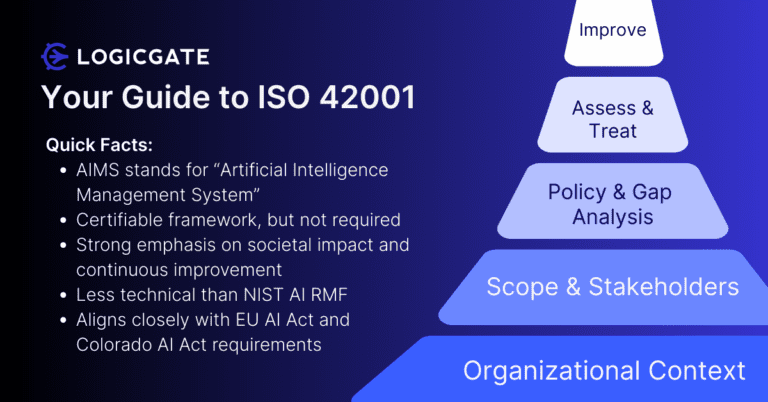
ISO 42001 is an international standard that specifies requirements for establishing, implementing, maintaining, and continually improving an Artificial Intelligence Management System (AIMS). It helps organizations govern AI responsibly by addressing risk management, transparency, accountability, and continual improvement across the AI lifecycle.
Sources: ISO/IEC 42001 · NIST AI RMF · EU AI Act
The Rise of AI: Why Standards Like ISO 42001 Matter More Than Ever
Artificial intelligence (AI) is reshaping industries at an unprecedented pace, from healthcare to finance. As organizations race to integrate AI technologies into their business operations, the need for robust AI governance has never been more critical. While the benefits of AI are vast, they come with significant challenges regarding data protection, ethical considerations, and security vulnerabilities.
This brings us to a pivotal question: how can organizations innovate quickly and responsibly while effectively managing the lifecycle of their AI systems? The answer lies in standardization. Just as ISO 27001 became the gold standard for information security, ISO/IEC 42001 is emerging as the essential international standard for managing the risks and opportunities associated with AI amidst a fractured landscape of regional and global regulations.
Understanding the Core: What is ISO 42001?
ISO 42001 is the world’s first management system specifically designed for AI. It provides a structured framework for establishing, implementing, maintaining, and continually improving an Artificial Intelligence Management System (AIMS).
What is an AI Management System (AIMS)
An Artificial Intelligence Management System, or AIMS, is not just a set of rules — it is a holistic approach to AI risk management. It integrates governance frameworks into an organization’s existing structures, ensuring that AI initiatives are not siloed but are treated as a core part of the organization’s strategy.
By adopting an AIMS, organizations can move beyond ad-hoc AI practices and establish rigorous workflows that cover everything from data management to impact assessment and validation. This system helps organizations navigate the complex lifecycle of AI, ensuring that continuous monitoring and continuous learning are embedded in their processes.
The Vision and Purpose Behind ISO 42001
The primary vision of ISO 42001 is to provide a framework for building and implementing AI responsibly. The standard aims to balance the need for innovation with the necessity of responsible use. By providing a clear risk management framework, ISO 42001 helps organizations identify potential risks, such as bias in machine learning models or cybersecurity threats, and implement effective mitigation strategies. Proposed organizational objectives provided by ISO 42001 include the following themes, but are not limited to:
- Established Accountability: Proactively redefine responsibility structures to ensure that human oversight remains central, even when actions are supported or driven by automated systems.
- Interdisciplinary Expertise: Cultivate and maintain a workforce of dedicated specialists with the diverse skill sets necessary to assess, develop, and deploy AI responsibly.
- Data Integrity and Privacy: Prioritize the availability, quality, and ethical handling of training and test data to ensure intended system behavior and protect data subject privacy.
- Reliable and Equitable Outcomes: Ensure systems perform consistently under varying conditions, actively mitigate bias, and prioritize the protection of life, health, property, and the environment.
- Transparency and Explainability: Maintain an open operational culture and provide clear, human-understandable explanations regarding the factors influencing AI results and organizational decisions.
- Sustainable Practices: Evaluate and manage the ecological footprint of AI operations to maximize positive environmental impacts and minimize harm.
Ultimately, the purpose extends beyond assurance to stakeholders, from customers to regulators, that an organization is committed to ethical AI and legal compliance. It transforms AI governance from a theoretical concept into a tangible reality that can be continuously assessed and approved, setting the stage for safer and more reliable use of AI systems.
Is ISO 42001 Certification a Regulatory Requirement?
As of March 2026, ISO 42001 is a voluntary, certifiable standard rather than a strict legal mandate. However, it is rapidly becoming the de facto operating system for AI compliance across the world. Leading practitioners recommend implementing an AIMS under ISO 42001 guidance, as it provides a flexible, future-proof framework that evolves alongside a volatile regulatory landscape.
By focusing on organizational context and scope, ISO 42001 ensures your controls align with current legal obligations. This harmonized approach allows organizations to meet multiple regulatory requirements through a single governance framework, preventing the need to build separate, siloed compliance programs for every new law.
Regulatory Alignment & Strategic Advantages
ISO 42001 is specifically designed to support compliance with major frameworks, including:
EU AI Act: While not yet a harmonized standard in the Official Journal, ISO 42001 provides the structural foundation for the Article 17 Quality Management System (QMS) required for high-risk AI providers. It mirrors the Act’s emphasis on risk management, data governance, and post-market monitoring.
Colorado AI Act: Taking full effect in June 2026, this law provides an affirmative defense against enforcement actions for algorithmic discrimination. Organizations that can demonstrate a risk management program aligned with a recognized framework like ISO 42001 may establish reasonable care to protect consumers.
Texas Responsible AI Governance Act (TRAIGA): Effective January 1, 2026, this act prohibits specific discriminatory intents and behavioral manipulation. ISO 42001’s incorporation of impact assessments and documentation requirements provide the evidentiary trail needed to prove a lack of discriminatory intent and verify biometric data protections.
Emerging Global Standards: Bias, transparency, and safety are the primary drivers of new legislation. Because ISO 42001 treats these as core operational objectives, certified organizations are well positioned to meet new requirements.
What is the Difference Between ISO 42001 and the NIST AI RMF?
| ISO/IEC 42001 (AIMS) | NIST AI RMF | |
| Certifiable? | Yes. Requires formal third-party audits to prove compliance. | No. Voluntary “how-to” guide for managing risk with no formal certification. |
| Structure | Plan-Do-Check-Act (PDCA). Focused on organizational governance, policy, and continuous improvement. | Core Functions. Structured around Govern, Map, Measure, and Manage with a focus on prescriptive, system-level controls. |
| Main Objective | Establishing an auditable Management System (AIMS) that promotes responsible AI in the context of each organization. | Improving the “Trustworthiness” of AI systems (Fairness, Safety, etc.). |
| Global Standing | High. ISO is recognized internationally and referenced in the EU AI Act. | Moderate. NIST is considered the “gold standard” for technical risk assessment, especially in the US. |
Key Components of an ISO 42001 Compliant AI Management System
Core steps toward ISO 42001 certification include the strategic establishment, implementation, maintenance, continual improvement, and documentation of an AIMS. This international standard is not a one-size-fits-all prescription, but rather a framework that must be tailored to the specific context of each organization. Below, you will find recommended steps toward a successful implementation. Please note, this guidance is meant to be high-level and the official ISO 42001 documentation should be referenced as the single source of truth.
1) Establish: Context and Scope
This phase is about understanding the unique ecosystem in which your organization and AI usage inhabit. ISO 42001 is highly customizable, meaning it is a pre-requisite to identify internal and external factors that influence your AI objectives. Key steps in this phase of implementation include:
- Defining Your Organization’s Role: Document whether you are a Provider (building systems), Producer (modifying them), or User (deploying third-party tools) for each AI system. Your compliance requirements scale based on this role.
- Mapping Outcomes to Issues: Identify Outcomes in Annex C that are most relevant to your organization, then document what issues may prevent your organization’s ability to achieve those intended outcomes.
- Mapping Stakeholder Expectations: Identify regulators, customers, employees, and other stakeholders then document their specific requirements for transparency and fairness. This should also include the current risk appetite of your organization.
- Establishing AIMS Scope: Based on the context above, determine which business units and AI systems should be included. A focused scope allows for accelerated implementation and potentially faster certification.
Remember, the expectation is that you will continuously adjust the context and scope to accommodate inevitable changes in your organization and the landscape within which you operate.
2) Govern: Policies, Procedures, and Leadership Involvement
Once the scope is established, the focus shifts to creating a robust governance structure. This phase focuses on accountability and establishing rules of engagement for AI within your organization. By aligning top-down leadership commitment with bottom-up operational procedures, you ensure that responsible AI practices are woven into the fabric of the company’s culture rather than treated as an isolated IT requirement. Key steps include:
- Establishing an AI Policy: Draft a foundational policy that aligns with your strategic direction and existing InfoSec (ISO 27001) and Privacy (GDPR) frameworks. This should also include documented requirements for data quality and third-party risk management processes to ensure vendors meet your responsible AI standards.
- Conducting a Gap Analysis (Recommended but not required by ISO): Evaluate your current policies and procedures against Annex A controls to identify what existing materials are in scope and where new materials need to be drafted.
- Aligning on Resource Allocation: Ensure the team has the necessary AI expertise and the technical infrastructure to monitor systems effectively.
- Involving Leadership: Leaders must be involved in defining an AI policy aligned to the strategic direction of the organization, assigning roles, and ensuring continuous improvement of the AIMS is integrated into business processes.
3) Operationalize: Assessment and Treatment
In the operational phase, high-level policies are translated into technical and ethical safeguards. Here, you’ll be required to take a dual-lens approach: an internal view to ensure system reliability and an external view to protect society. By conducting specialized assessments, the organization can distinguish between acceptable risks and those that require immediate mitigation or decommissioning. This includes:
- AI System Impact Assessments: Evaluate how the system affects fundamental rights, fairness, and privacy of external entities, groups, or individuals. You can reference ISO 42005 for more granular guidance on how to perform said impact assessments.
- AI Risk Assessments: Map technical risks (like data poisoning, model drift, and hardware failure), then evaluate their likelihood and impact. These risk assessments are more aligned with standards like ISO 27001, focusing more on internal systems
- Operationalizing Controls: Apply specific treatments from Annex A and B to mitigate the risks identified in your assessments across the entire AI lifecycle.
4) Improve: Monitor, Audit, and Analyze
The final phase of successfully implementing ISO 420001 requirements ensures that the AIMS is not a static document, but a high-performing system capable of adapting to new threats and technological shifts. Through a rigorous cycle of monitoring and auditing, the organization can identify failures, learn from nonconformities, and continuously refine its AI posture. Key components include:
- Continuous Monitoring: Track model performance and safety metrics at planned intervals.
- Internal Audit: Conduct a formal internal audit to ensure the AIMS is effectively implemented and maintained.
- Management Review: Leadership must review the AIMS performance and approve corrective actions for any nonconformities.
- Continuous Improvement: It is critical that the source of any nonconformities are analyzed and the effectiveness of corrective actions are reviewed. You should also identify a cadence for reassessing the context and scope of your AIMS to ensure continued alignment with target outcomes.
How to Get Started: Implementing ISO 42011
A formal AI Management System (AIMS) transforms AI risk from a liability into a business enabler. By creating a structured environment for innovation, an AIMS empowers your enterprise to adopt cutting-edge technology with the confidence that your usage is ethical, secure, and resilient against a fragmented regulatory landscape.
The journey toward ISO 42001 certification begins with a strategic assessment of your organizational context. The goal is to define a manageable scope, identifying exactly which business units and AI systems are included in your governance perimeter. To ensure this phase is effective, be sure to:
- Engage Cross-Functional Stakeholders: Bridge the gap between technical subject matter experts, legal counsel, and executive leadership to ensure alignment on risk appetite.
- Establish a Foundation of Policy: Use your scope to draft an overarching AI policy. This document acts as your North Star, aligning governance, risk, and compliance (GRC) functions under a single set of ethical and operational standards.
- Leverage Gap Analysis: While not a strict requirement for the standard itself, a pre-implementation gap analysis is the best way to visualize your path to audit-readiness and prioritize resource allocation.
The multi-faceted nature of AI means governance cannot happen in a silo. Selecting a purpose-built platform is critical to accelerating your AIMS and preventing friction. When evaluating tooling like LogicGate Risk Cloud, prioritize capabilities that move you from siloed data entry to interconnected workflows, like:
- Automated AI Use Case Management: Centralize the intake and approval of AI initiatives, ensuring every model is linked to its relevant risks, policies, and impact assessments from day one.
- Third-Party Transparency: Automate vendor security questionnaires to ensure third-party AI integrations comply with your internal AI standards and data quality
- Integrated Framework Mapping: Reduce duplication by cross-walking ISO 42001 controls with your existing internal controls and other standards to create an “assess-once, comply-many” approach.
About LogicGate
LogicGate is the leading AI GRC platform for the enterprise — built for connectivity, resilience, and scale. GRC teams are empowered to create order from chaos by unifying data, automating workflows, and gaining a single pane of glass for strategic decision making. Request a demo to see how you can accelerate your implementation of ISO 42001 with out-of-the-box AI governance workflows that integrate with existing policy, cyber risk, third-party risk, data privacy, and compliance management programs.
FAQs About ISO 42001
Organizations typically establish context and scope, govern through policies and leadership involvement, operationalize AI impact and risk assessments with Annex A and B controls, and then monitor, audit, review, and continually improve the AIMS.
ISO 42001 focuses on AI governance through an Artificial Intelligence Management System (AIMS), while ISO 27001 focuses on information security. The two standards are complementary: ISO 27001 addresses information security management, and ISO 42001 adds AI-specific governance, transparency, impact assessment, and lifecycle oversight.
The core management system clauses generally emphasized are Clauses 4 through 10: context of the organization, leadership, planning, support, operation, performance evaluation, and improvement. Organizations also use Annex A controls, Annex B implementation guidance, and Annex C objectives and outcomes during implementation.
As of March 2026, ISO 42001 is a voluntary, certifiable standard rather than a strict legal mandate. However, it can help organizations align a single AI governance framework to multiple regulatory requirements as laws continue to evolve.