What is Operational Risk?
Operational risk is the risk of loss resulting from failed or ineffective internal processes, people, systems, or external events that disrupt normal business operations.
Operational risk is defined under Basel II as the risk of loss from inadequate or failed internal processes, people, systems, or external events. In short, it’s the risk that an employee makes a mistake, a process fails, or a system breaks down. This can become compromised, leading to a risk event.
What is Operational Risk Management?
Operational risk management is the process of identifying, measuring, reporting, managing, and mitigating operational risk across an organization.
The natural response to operational risk of any kind is to find ways to manage it. That’s where operational risk management enters the picture. Operational risk management is a subdiscipline of enterprise risk management that provides for processes for identifying, measuring, reporting, managing, and mitigating operational risk.
A cyberattack is stifled before it affects a single one of your servers. You’ve got loads of cash reserves to weather the economic downturn.
Supply chain problems? You’ve got back-up suppliers lined up six ways from Sunday.
The walls of your organization are a risk-proof fortress.
But risk doesn’t stop at your office walls or your firewalls. Risk leaders need to consider all of the things that could go wrong inside their organization as well. Managing this type of risk is known as operational risk management.
Standing up an operational risk management program is similar to building strategic or enterprise risk programs, but it also differs in key ways. This article will dive into what types of operational risk organizations face and how to identify, measure, and mitigate the ones threatening your own business.
Here are a few examples of what operational risk from each category might look like:
1. People: Operational risks from people can result from inadequate staffing, overlooked tasks, ignored policies, malicious insider activity, or ineffective training.
- Takeaway: people risk rises when staffing, training, or policy adherence breaks down.
2. Processes: The more complex your internal processes are, the higher the chance crucial steps get missed and operations become broken, delayed, or more costly.
- Takeaway: process complexity increases the likelihood of missed steps and operational disruption.
3. Systems: Cybercrime and other cyber threats are on the rise. Falling victim can lead to damaging data breaches or cripple your organization.
Failing to properly secure your systems and detect bad cyber actors can expose your organization to operational risk.
- Takeaway: weak or compromised systems can create severe operational and security failures.
4. External events: This type of operational risk came into full focus during the COVID-19 pandemic. It shut down the global economy and supply chains for nearly two years.
Any events interrupting your business’s operations are external operational risks. Examples include political changes, earthquakes, or hurricanes. These risks can also fall under the category of enterprise risks.
- Takeaway: disruptions outside your organization can interrupt operations just as forcefully as internal failures.
How Can Operational Risk Affect Your Organization?
Every company faces operational risk every day just by virtue of doing business. As operations grow more complex, things fall through the cracks. Policies may go uncommunicated as the workforce grows, and unmonitored controls begin to fail.
All of this increases exposure to operational risk over time, making it more likely that one will materialize and impact your revenue or brand reputation.
What Are the Types of Operational Risk?
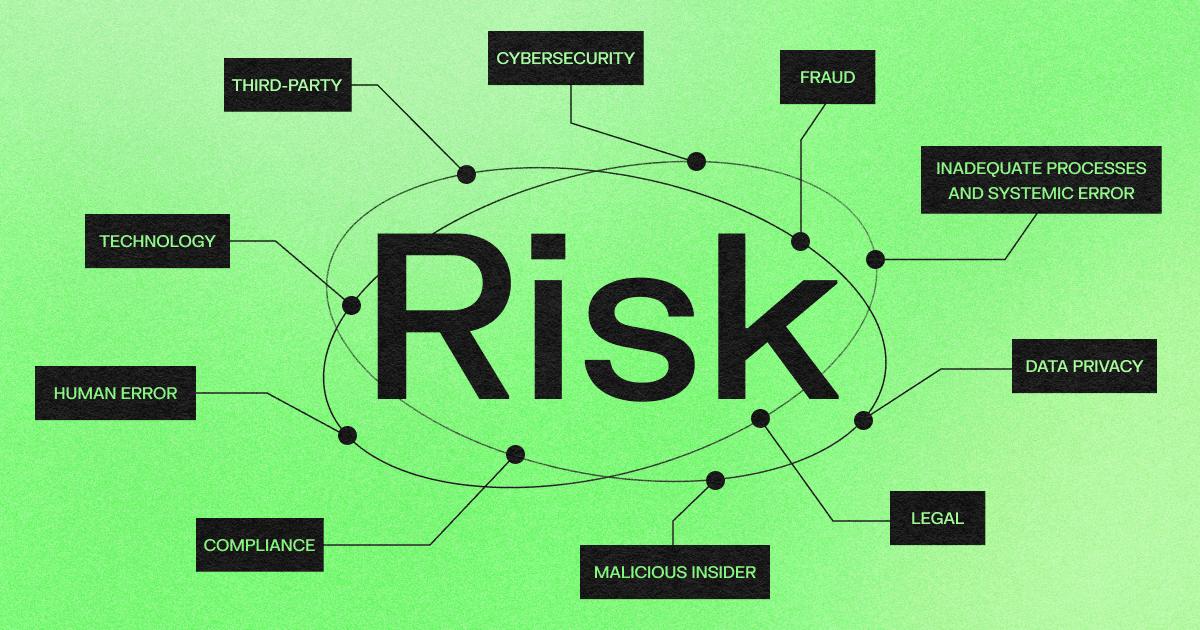
Operational risk comes in many forms. Many are unique to your industry, but here are the most common types you can expect to face.
- Compliance risk: Regulatory non-compliance can result in audit findings, fines, and penalties.
- Takeaway: compliance failures lead to audits, fines, and penalties.
- Third-party risk: Every vendor relationship expands your operational risk surface through direct and indirect connections.
- Takeaway: every vendor relationship expands your operational risk surface.
- Cybersecurity risk: Connected devices create entry points for attacks.
- Takeaway: every connected device can become an entry point for disruption.
- Technology risk: System failures can slow, halt operations, or cause significant downtime during digital transformations.
- Takeaway: unreliable technology can slow, stop, or damage core operations.
- Data privacy risk: Poor data protection harms customers and triggers penalties.
- Takeaway: poor data protection can harm customers and trigger regulatory fallout.
- Human error risk: Many operational errors are preventable with proper controls and training.
Takeaway: many operational failures are preventable with better controls and training. - Malicious insider and fraud risk: Insider threats can be intentional.
- Takeaway: insider threats can be intentional, not accidental.
- Occupational safety risk: Safety hazards affect physical and mental health.
- Takeaway: safety risk applies across roles and industries.
- Legal risk: Operational failures often create legal consequences.
- Takeaway: operational failures often create legal consequences as well.
What Are Common Operational Risk Examples?
Here are real-world operational risk examples from recognizable brands, institutions, and emerging technologies:
- Vendor risk – Target: Target was hacked through a third-party HVAC contractor’s compromised credentials.
- Takeaway: third-party access can become a direct path into your environment.
- Technology and human error risk – Citibank: Poor interfaces amplified human error.
- Takeaway: poor system design can amplify human error into loss.
- Technology risk – Generative Artificial Intelligence: Emerging technologies pose threats to models.
- Takeaway: new technologies can create operational pressure on models.
- Compliance risk – Binance and Coinbase: Compliance lapses resulted in $4.3 billion and $100 million in penalties.
- Takeaway: compliance lapses can produce costly regulatory action.
- Occupational safety risk – National Football League (NFL): The NFL paid $765 million for concussion injuries.
- Takeaway: safety failures can create long-term financial and reputational exposure.
- Data privacy/cybersecurity risk – T-Mobile: T-Mobile paid $500 million for a data breach.
- Takeaway: privacy and cybersecurity incidents can become extremely expensive.
What is the Goal of Operational Risk Management?
The end goal of any operational risk management program is to anticipate and prevent operational risks from materializing and causing problems. Companies with fewer operational risk events earn more trust. That improves investor confidence, brand reputation, and the bottom line.
What Is the Difference Between Operational Risk Management and Strategic Risk Management?
While operational risk can stem from strategic risks and errors associated with them, the two are distinct concepts. Operational risks come into play when processes fail, policies are ignored, systems break down, or other events interrupt business flow.
Strategic risks, on the other hand, are related to the overall planning, management, and strategy of the business. These include unclear goals, departmental siloing, management turnover, competitors eating into revenue, or a poorly executed merger or product launch.
Operational risk management puts a much heavier emphasis on protecting the organization from risks that could cause problems. Strategic risk management, by contrast, focuses on finding the right risks to take, rather than avoid, to generate strategic and competitive advantage.
What Are the Four Principles of Operational Risk Management?
Few organizations deal with higher-stakes risk scenarios than the U.S. military. They put extensive time and resources into developing operational risk management programs.
The U.S. Navy has developed four specific principles that underpin their operational risk management process:
- Accept risks when the benefits outweigh the cost: Take risks to achieve goals with proper approval.
- Takeaway: accept risk only when the upside clearly justifies it.
- Accept no unnecessary risks: Avoid risks with negligible benefits.
- Takeaway: avoid risks that add little value.
- Anticipate and manage risk by planning: Develop plans and controls to mitigate risks.
- Takeaway: planning and controls are central to resilience.
- Make risk decisions at the appropriate level: Empower teams with clear risk tolerance.
- Takeaway: empower teams with clear authority and tolerance.
How Do You Establish Effective Frameworks and Policies for Managing Operational Risk?
Now that we understand operational risk and its management, let’s get into how to build a program for managing it. We’ll cover the basics of assessing your organization’s operational risks. We’ll also explore advanced techniques like key risk indicators and risk quantification.
What Is an Operational Risk Management Framework?
An ORM framework connects your risk appetite, policies, controls, and reporting into one consistent system. Most programs build theirs around a recognized governance model, like the IIA’s Three Lines Model, so every risk has a clear owner and a clear reporting line.
How Do You Govern an Operational Risk Program?
Governance assigns accountability across three lines:
- First line: your business units who own and manage risk day to day
- Second Line: risk and compliance that sets policy and monitors the first line
- Third Line: internal audit that independently assures the board that both are working
The board or a designated risk committee sets the tone from the top. They approve risk appetite, review material risk events, and hold management accountable for control effectiveness.
Takeaway: clear ownership across all three lines is what keeps operational risk from becoming everyone’s job and no one’s job.
What Is a Risk and Control Self-Assessment (RCSA)?
An RCSA is a structured exercise where business units identify their risks, evaluate the controls meant to mitigate them, and flag gaps for remediation. It’s the engine that feeds your risk register and KRIs with real data instead of assumptions.
A typical RCSA cycle identifies and prioritizes risks, assesses likelihood and impact, evaluates control effectiveness, and builds a corrective action plan. See common RCSA bottlenecks and how to fix them.
Takeaway: a well-run RCSA turns operational risk from a point-in-time guess into a documented, repeatable assessment.
How Do You Set Risk Appetite and Risk Tolerance?
Risk appetite is the overall level of risk your organization will accept in pursuit of its goals, usually captured in a single statement the board approves. Risk tolerance sets specific thresholds for each individual risk, informed by that appetite.
A conservative risk appetite might set zero tolerance for critical system outages. A more aggressive one might accept brief downtime in exchange for faster releases. See risk appetite vs. risk tolerance in more detail.
Takeaway: risk appetite tells you how much risk to accept. Risk tolerance tells you exactly where the line is for each one.
How Do You Identify Your Operational Risk?
It’s impossible to start effectively managing operational risk without knowing which operational risks you’re facing. That’s why the first step is to get a clear view of your organization’s entire risk landscape.
How Do You Assess, Quantify, and Prioritize Your Operational Risk?
Then, you can begin to prioritize which operational risks pose the gravest threat to your business. Use risk quantification and risk scoring methods like Monte Carlo simulations and the Open FAIR framework. These tie each risk to its potential financial impact.
Risk Cloud Quantify® packages this same Monte Carlo and Open FAIR-based logic into a no-code workflow, built for teams without a dedicated actuarial function.
In one customer example, a global company with 500+ locations used analytics and Risk Cloud® to feed metrics into its risk assessment process. That helped internal audit review lower-risk locations remotely and focus onsite reviews on higher-risk sites.
How Do You Develop a Plan to Mitigate Operational Risk?
With your prioritized list of risks in hand, you can now begin taking steps to mitigate operational risk in a variety of ways.
- Transferring risk: Purchase insurance to absorb costs of potential incidents like data breaches.
- Avoiding risks: Eliminate the risk by exiting markets or products, though this limits opportunities.
- Accepting risks: Accept risks when benefits clearly outweigh costs and downside is minimal.
- Implementing controls: Place guardrails to operate with risk present while preventing major problems.
Once you’ve finished assessing each risk and developing mitigation plans, communicate them clearly throughout your organization.
How Do You Continuously Monitor Operational Risk?
Change is constant in operational risk management. You must always measure, monitor, and adjust your controls and plans. Your plans should include a regular cadence for evaluating and improving controls.
An effective way for conducting continuous controls monitoring is by developing a good set of key risk indicators.
How Do You Set KRIs for Measuring Operational Risk?
Key risk indicators, or KRIs, are metrics designed to warn you of impending risk events or trends that could lead to risk events. They estimate the overall likelihood that the risk being monitored will occur, how fast that could happen, and the potential impact if it does occur.
You can assign KRIs to each of your operational risks as follows:
- Identify Root Causes: Work backwards from each risk to identify root causes and events needed for materialization.
- Map Data Sources: Identify data sources to measure event occurrences, such as CRM data for churn or phishing simulations.
- Track Trends: Create dashboards using modern GRC software to track KRI trends.
How Do You Benchmark Your Operational Risk Program’s Maturity?
Knowing your risk exposure isn’t enough. You also need to know how mature your program is against your peers. LogicGate’s GRC Maturity Workshop scores programs across five competencies, strategy, process, people, technology, and metrics, on a 0 to 4 scale from Undefined to Optimized, then benchmarks the result against similarly-sized organizations.
United Community Bank used this methodology to benchmark its risk and controls management programs. Controls management scored furthest below target, so the bank built a two-year roadmap to close the gap. Read the full GRC maturity case study.
Customers who act on a maturity roadmap see it show up in the numbers: LogicGate customers have automated more than 20,000 workflows, gained 25%+ task efficiencies, and saved $250K+ annually through automation.
Takeaway: a validated maturity score, not a gut check, is what turns “we should improve operational risk” into a fundable roadmap.
What Are Common Challenges and Mistakes in Operational Risk Management?
Operational risk management has its own challenges and pitfalls. These can derail plans or expose your organization to additional risk. Here are a few of the common challenges and mistakes made in operational risk management.
- Relying on manual processes: Manual execution introduces error. Solution: Automate with GRC technology.
- Siloing of risk data: Centralize risk data for team alignment. Solution: Use GRC technology.
- Difficulty getting executive buy-in: Communicate risks clearly and report effectively.
- Difficulty scaling programs: Use GRC technology to automate. See how to choose a GRC platform.
How Can You Fortify Your Operational Risk Strategy?
There’s no avoiding it: If you’re operating a business or any other type of organization, you’re going to have to deal with operational risk. Standing up an effective operational risk management program is the best way to get ahead of, and stay ahead of, any risk facing your business.
The examples above didn’t come from a lack of good intentions. They came from gaps a connected system would have caught: compromised credentials, confusing interfaces, and untracked compliance controls. That’s the gap a real operational risk program closes.
Risk Cloud provides one place to identify risks, assign KRIs, and quantify impact. Show auditors and your board that your program works.
Book a demo today to see how Risk Cloud can help you build a more resilient operational risk management program.
Frequently Asked Questions
Operational risk is the chance that failed processes, people, systems, or external events will disrupt normal business operations and cause loss. It covers issues like human error, cyber incidents, system outages, vendor failures, and compliance breakdowns. In practice, it is the risk created by how work gets done.
Operational risk management is the discipline of identifying, assessing, measuring, monitoring, and mitigating operational risk. A strong program helps organizations set controls, track KRIs, report issues, and respond before routine breakdowns turn into financial, legal, or reputational damage. The goal is continuity, resilience, and fewer preventable losses.
The four core sources of operational risk are people, processes, systems, and external events. Common types include compliance risk, third-party risk, cybersecurity risk, technology risk, and data privacy risk. Also: human error, insider fraud, occupational safety, and legal risk. Most programs start by mapping risks to these buckets.
Measure operational risk by identifying risk events and estimating likelihood and impact. Assign KRIs and use scoring methods like Monte Carlo simulations or the Open FAIR framework. The objective is to prioritize the risks most likely to disrupt operations or create material financial loss.
Operational risk concerns failures in day-to-day execution, such as broken processes, ignored policies, outages, or employee mistakes. Strategic risk concerns decisions about direction, priorities, competition, mergers, or products. Operational risk management focuses on preventing disruption; strategic risk management also evaluates which risks may be worth taking for advantage.